



Why Segmentation Often Fails in MedTech
Segmentation is one of the most powerful tools in healthcare market research.
Yet in medical devices, it often fails to deliver meaningful impact. Not because the methodology is wrong, but because it is not designed with a clear purpose in mind.
Too often, segmentation becomes an analytical exercise—interesting, detailed, and statistically robust—but disconnected from the decisions it is meant to inform.
👉 If a segmentation doesn’t change how you price, target, or position your product, it isn’t doing its job.
The Only Question That Matters
When designing a segmentation, teams often focus on methodology first. Should we use cluster analysis? Latent class? Something more advanced?
But this is the wrong starting point.
The real question is:
👉 What decisions will this segmentation actually change?
In MedTech, this matters more than in most industries. Adoption is rarely driven by a single stakeholder. Clinical needs, procurement processes, budget constraints, and care pathways all shape decision-making. A segmentation that ignores this complexity may look elegant—but it won’t be useful.
The most effective segmentations are those built with a clear understanding of how they will be used.
Start by Defining the Role of the Segmentation
Before choosing a methodology, it’s important to define what the segmentation needs to achieve.
In practice, segmentations in medical devices typically serve one (or more) of four roles: helping teams prioritize customers, uncovering unmet needs, informing pricing, or shaping the value proposition.
Each of these requires a different lens.
A segmentation designed to support pricing, for example, needs to be tightly linked to willingness to pay and trade-offs. One designed for targeting needs to be easily identifiable in the real world and usable by commercial teams.
The key is focus. The more clearly the role is defined upfront, the more effective—and actionable—the segmentation will be.
Segmentation Methodologies in Practice
There is no single “best” methodology. The right choice depends on what you are trying to achieve.
Cluster Analysis: Structuring and Exploring the Market
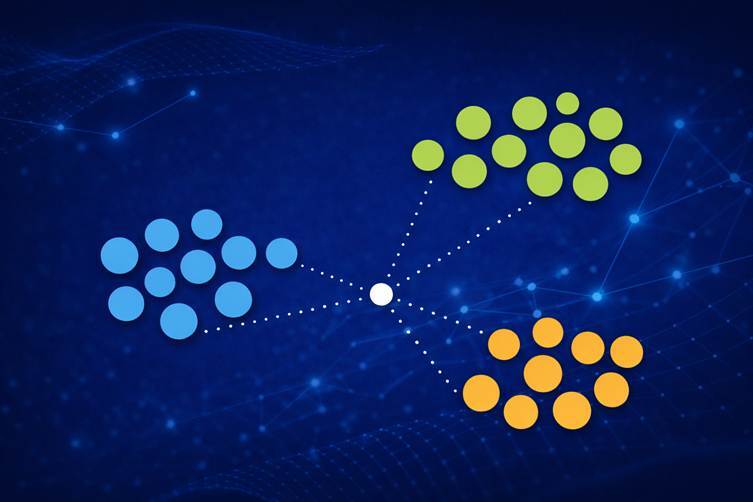
Cluster analysis is often the starting point when the market is not yet fully understood. It groups respondents based on similarities in attitudes, behaviors, and needs, helping to reveal how the market naturally segments.
This approach works particularly well in early-stage work—such as understanding clinical practice, mapping patient pathways, or identifying unmet needs—where the goal is to explore variation rather than make immediate commercial decisions.
However, while cluster analysis is intuitive and flexible, it often requires additional work to translate findings into something directly actionable. It provides structure, but not always clear direction.
Latent Class Analysis: Supporting Strategic Decisions

When segmentation is intended to inform high-stakes decisions—such as pricing, investment, or portfolio strategy—latent class analysis is often more appropriate.
Unlike cluster analysis, it assigns respondents to segments probabilistically, capturing the fact that real-world behavior is rarely clear-cut. This makes it particularly useful when linking segmentation to choice modelling, pricing research, or behavioral data.
The result is a more robust and defensible segmentation. The trade-off is complexity: these models require careful interpretation to ensure they remain clear and usable for stakeholders.
CHAID: Translating Insight into Action
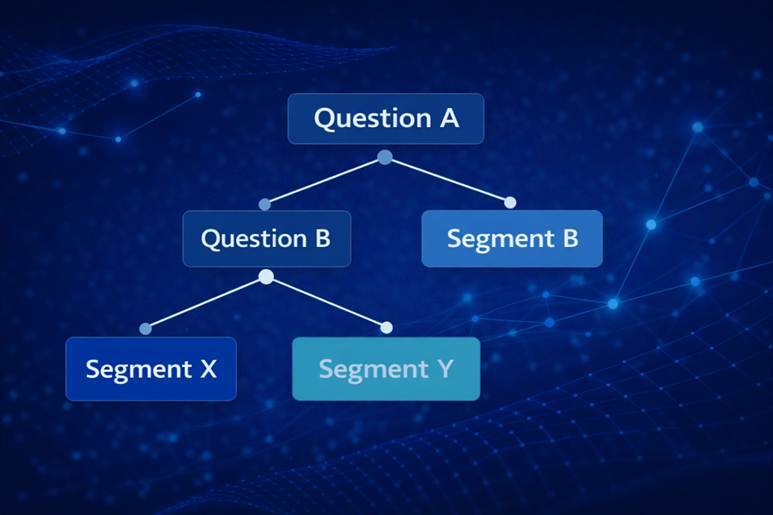
While cluster and latent class approaches focus on understanding the market, CHAID is designed to make segmentation actionable.
It builds decision trees that show how different variables—such as setting, patient type, or institutional factors—drive behavior. This makes it particularly valuable when the goal is to support commercial teams with clear rules for targeting and engagement.
In practice, CHAID is often used to bridge the gap between insight and execution. It may not capture the full complexity of attitudes and behaviors, but it excels at turning analysis into something teams can use.
Choosing the Right Approach
In practice, the choice of methodology should always be guided by the intended use.
If the goal is to explore and structure the market, cluster analysis is often sufficient. If the segmentation needs to underpin strategic decisions, a more robust approach such as latent class is typically required. And if the priority is activation—ensuring the output can be used in the field—then methods like CHAID come into their own.
The key is not to apply multiple methodologies for the sake of it, but to select the one that best supports the decision at hand.
Where Segmentation Goes Wrong in Medical Devices
Segmentation in MedTech often falls short for predictable reasons.
In some cases, it becomes overly complex, producing segments that are statistically distinct but impossible to identify in practice. In others, it fails to account for the realities of healthcare systems—such as procurement structures, reimbursement constraints, or clinical pathways.
Perhaps most commonly, segmentation is conducted in isolation from commercial decision-making. It describes the market, but does not shape what happens next.
The result is insight that is interesting—but not actionable.
When Segmentation Adds Real Value
Segmentation delivers the most value when it directly informs decisions.
This might mean helping teams prioritize which customers to target, clarifying differences in needs or behaviors, or identifying how pricing and value perception vary across segments.
However, segmentation is not always the right tool. In some situations, approaches such as conjoint studies, or pathway mapping may provide more direct answers.
The key is to remain focused on the outcome:
👉 Will this segmentation change what you do next?
What Good Segmentation Looks Like in MedTech
A strong segmentation reflects how decisions are actually made in the real world.
It accounts for the complexity of healthcare systems—where clinical, economic, and organizational factors all play a role—and ensures that segments can be identified and targeted in practice.
Most importantly, it links directly to action. Whether that’s refining a value proposition, adjusting pricing, or prioritizing specific customer groups, a good segmentation makes the next step clearer.
Final Thought
Segmentation in medical devices is not about applying the most advanced methodology.
It’s about applying the right structure to support better decisions.
When done well, it provides a way to navigate complexity—and translate insight into meaningful commercial action.
Need a Segmentation That Drives Decisions?
If you’re planning a medical device segmentation project—or questioning whether your current one is truly actionable—we’d be happy to help.
At IDR Medical, we design segmentation frameworks that go beyond insight to drive pricing, targeting, and go-to-market strategy. Discover our medical device market research services, supporting MedTech companies across the US, Europe, and global markets.
👉 Get in touch to discuss your objectives with one of our experts.